Research
Wakes of surface-mounted bluff bodies of small aspect ratio
Despite the simple configuration of a surface-mounted finite-height square prism, the flow around it presents intricate three-dimensional vortex structures, whose characteristics and formation mechanisms are not very well understood. This is especially the case for prisms of small aspect ratio AR = H/D (where H is the height and D is the width of the prism).
By combining extensive wind tunnel measurements and large-eddy simulations, our research revealed a new wake topology for AR < 1, with the appearance of an inner vorticity pair instead of tip vortices. This pattern and associated force coefficients were found to depend on both AR and the thickness of the ground plane boundary layer, δ. We also consolidated our knowledge of the wake of a surface-mounted cube (AR = 1) through an updated flow model, connecting the three-dimensional flow structures to the near-wall flow field and considering effects of δ, giving a complete picture of the mean and dynamic flow.
References:
da Silva, BL; Sumner, D; Bergstrom, DJ. (2024). On the flow dynamics around a surface-mounted cube and boundary layer effects. Journal of Fluid Mechanics 991, A17.
da Silva, BL; Sumner, D; Bergstrom, DJ. (2024). Revisiting the surface-mounted cube: An updated perspective of the near wake and near-wall flow field. International Journal of Heat and Fluid Flow 106, 109288.
da Silva, BL; Hahn, DGH; Sumner, D; Bergstrom, DJ. (2022). Mean wake and aerodynamic forces for surface-mounted finite-height square prisms of very small aspect ratio. Physics of Fluids 34, 115118.
da Silva, BL; Sumner, D; Bergstrom, DJ. (2022). Mean and dynamic aspects of the wakes of a surface-mounted cube and block. Journal of Fluids Engineering 144, 011302.
Vortex shedding from a surface-mounted cube. https://doi.org/10.1017/jfm.2024.551

Unsteady flow around obstacles
The fluid environment in most engineering, geophysical and biological applications is extremely complex, where unsteady features such as gusts, ocean waves and pulsatile pumping are commonplace. In the case of pulsating flow, the flow rate varies periodically in time, usually in a sinusoidal manner with characteristic frequencies and amplitudes.
Previous research has explored the specific context of pulsating flow in an artery with aneurysm through direct numerical simulations, revealing the role of turbulence in this type of flow and its sensitivity to the computational methods employed. We want to expand this investigation into instabilities generated by surface-mounted finite-height bluff bodies in pulsating flows, relevant to biomedical applications involving blood clots and vocal cord polyps, for example.
References:
Luciano, RD; da Silva, BL; Chen, XB; Bergstrom, DJ. (2024). Turbulent blood flow in a cerebral artery with an aneurysm. Journal of Biomechanics 172, 112214.
Wind assisted ship propulsion
Wind assisted ship propulsion technologies, particularly rotor sails, offer a promising solution by harnessing the Magnus effect to generate high lift-to-drag ratios and improve fuel efficiency. These devices operate at Reynolds numbers exceeding 10⁶ when installed in cargo ships, making experimental and numerical modeling challenging. Recent experimental results obtained by our collaborators at high Reynolds numbers have found strong dependencies on velocity ratio (the angular rotational velocity of the rotor divided by the flow velocity) and endplate configurations for lift generation, demanding a better understanding of these mechanisms to help optimize rotor sail designs.
Our group aims to help answer these questions through large-eddy simulations of the flow to investigate rotor end effects, including the formation process of flow structures and their relationship to the generation of lift.
Wake of a rotating cylinder (by Justin Sandrasagra)
Flow around an array of cylinders. https://doi.org/10.1016/j.ijheatfluidflow.2019.01.006
References:
da Silva, BL; Sumner, D; Bergstrom, DJ. (2025). Three-dimensional mean flow field around two cubes in tandem. International Journal of Heat and Fluid Flow 116, 109966.
da Silva, BL; Sumner, D; Bergstrom, DJ. (2024). Wake interference effects for two surface-mounted cubes in tandem. Physics of Fluids 36, 115104.
Wake interference effects
In most engineering applications, surface-mounted finite-height prisms are found in groups, such as buildings in urban environments, components of printed circuit boards, and roughness elements on a ship’s hull, for example. Understanding the wake interactions of groups of prisms is, therefore, essential to developing and optimizing applications where they are present.
Our work was one of the first to systematically investigate the wake interference effects for two surface-mounted cubes in tandem as a function of the proximity between the cubes and of the ground plane boundary layer thickness. We discovered an unsynchronized shedding regime for close cube proximity and thin boundary layers, and that increasing boundary layer thickness suppressed the low-frequency shedding from the upstream cube and the development of the cavity-locked regime. We also revealed the formation of a low-frequency wake drift for two cubes in tandem, showing that its mechanism changed depending on the flow regime.
Based on early work with arrays of infinite (two-dimensional) cylinders, it is expected that different and more complex flow regimes will take place for groups of surface-mounted finite (three-dimensional) bodies depending on both their longitudinal and transverse proximity. Therefore, one of our goals is to understand the patterns in the flow around small arrays of surface-mounted finite-height bluff bodies.
Fluid-structure interactions
Fluid-structure interactions are ubiquitous in nature and in engineering applications, from the bending of tree branches and leaves during a storm and the motion of underwater plants in ocean currents, to flow-induced vibrations of bridges, aircrafts and industrial equipment. These interactions arise from the tight coupling between fluid motion and structural deformation – a relationship governed by multi-physics phenomena. Accurately capturing these effects is often computationally intensive, especially when dealing with highly deformable surfaces such as in soft robotics and biomedical applications.
In the long-term, our research aims to establish a framework for the simulation of accurate fluid-structure interaction problems, enabling the study and optimization of designs and advancing applications in the energy, transportation and biomedical sectors.
References:
Bedenik, G. et al. (2025). Bistable SMA-driven engine for pulse-jet locomotion in soft aquatic robots. 2025 IEEE 8th International Conference on Soft Robotics (RoboSoft), Lausanne, Switzerland.
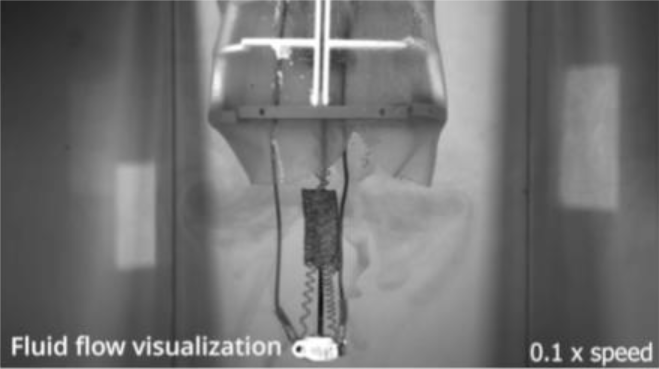
Flow visualization of wake of robot jellyfish designed by Bedenik et al. (2025), in collaboration with NERD Lab and Aerodynamics & Wind Energy Lab.